Tuesday, January 24, 2012

A collection of facts about Indian Paper Money by Mr. Rezwan Razack, author of ‘The Revised Standard Reference Guide to Indian Paper Money

Bank of Hindostan, a Private Bank issued the first banknotes of India in 1770. The lowest denomination in early issued banknotes was Rupees Ten and the highest was Rupees Ten Thousand.


Bank of Hindostan - Sixteen Sicca Rupees


The early banknotes were exchanged for silver or gold coins or vice versa.

One Silver Rupee


One Gold Mohur
There were banknotes with denominations of Rupees Four, Rupees Fifteen and Rupees Sixteen.
Sixteen silver coins were equivalent to One Gold Mohur of equal weight. One Gold Mohur weighed 11.59 grams.
The earliest surviving issued banknote is by The Bank of Bengal – Two Hundred and Fifty Sicca Rupees note dated 3rd September 1812.
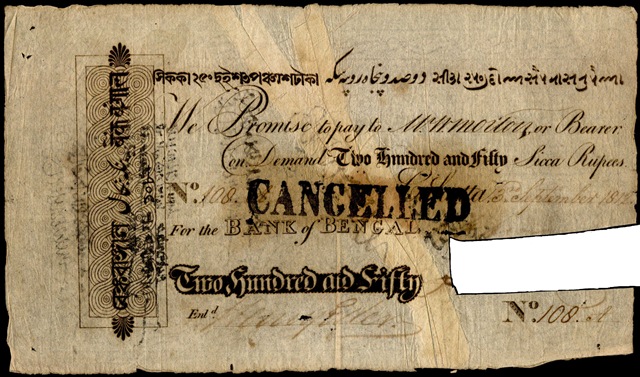


Bank of Bengal - Two Hundred and Fifty Sicca Rupees
OLDEST surviving Indian Bank Note - Serial No.108 dt. 3rd September 1812

Early banknotes had manuscript signature, date and serial number.

 
Madras Government Bank - Two Star Pagodas
The Government of India took over the issue of banknotes in 1861 from the Private and Presidency Banks.
The Uniface or one-sided notes of Government of India were in circulation from 1861 to 1930.
Government of India - Twenty Rupees - Uniface with Portrait of Queen Victoria
The first Rupees Five notes were Uniface and issued in 1871 by Government of India.
Government of India - Five Rupees - Uniface with Green under print
The only notes to have serial numbers in all four corners were from the Uniface Note series.
Initially the Uniface Notes, notes with the Portrait of King George V & King George VI had the Circle of Issue printed on the notes.
Portrait Note of King George V - One Hundred Rupees - Cawnpore
Circles of Issue Cawnpore and Kurrachee are now spelt Kanpur and Karachi.
The only issued type that does not have a title on the note, either Government of India or Reserve Bank of India.

Portrait Note of King George VI - One Hundred Rupees - Kanpur
The notes of Rupee One were first issued in 1917 with the Portrait of King George V. 25% of these Rupee One notes were issued in a booklet of 25 notes.
Portrait Notes of King George V - One Rupee
Portrait Notes of King George V - A booklet of 25 One Rupee Notes

Portrait Notes of King George V - A bundle of 25 One Rupee Notes
The second issue of Rupee One notes dated 1935 took place in 1940 with the Portrait of King George V, who died in 1936.
The 1935 Rupee One is the only note with Serial Number on the reverse.
Portrait Notes of King George V - One Rupee - Serial Number on Reverse
The One Rupee note had the year inscribed in the image of the coin on the Reverse from 1917-1994.

Government of India - One Rupee - with Coin dated 1917
Government of India - One Rupee - with Coin dated 1990
There was an issue of Rupees Two Annas Eight or Rupees Two and a Half in 1918.
Portrait Notes of King George V - Rupees Two Annas Eight
The Reserve Bank of India was established in 1935 as a central note issuing authority.
The Rupee One notes of Government of India were treated in Government accounts at par with metallic coins.
The Secretary of the Finance Department, Government of India, signed these Rupee One notes.
Government of India - One Rupee
The first Rupees Two notes were issued in 1943 with the Portrait of King George VI.
Reserve Bank of India - Two Rupees - with Portrait of King George VI
Notes issued by Government of India and Reserve Bank of India were overprinted for use in Burma.
Reserve Bank of India - Five Rupees - Burma
Notes issued by Reserve Bank of India were overprinted ‘Government of Pakistan’ in 1947 at the Nasik Press for use in Pakistan until 1948.
Reserve Bank of India - Rupees Five with Government of Pakistan Overprint
Notes of Independent India were first released in 1949 in Rupee One and Rupees Ten and later in all denominations in 1950.
Government of India - One Rupee
Notes of all denominations issued by the Reserve Bank of India after independence have the Ashoka Pillar and the Seal of Reserve Bank of India.
Reserve Bank of India - Twenty Rupees
The Mahatma Gandhi Birth Centenary Commemorative Issue in 1969 is the only the commemorative issue by the Reserve Bank of India.
Reserve Bank of India - One Rupee - Mahatma Gandhi Commemorative Issue
Reserve Bank of India - Two Rupees - Mahatma Gandhi Commemorative Issue
Reserve Bank of India - Five Rupees - Mahatma Gandhi Commemorative Issue
Reserve Bank of India - Ten Rupees - Mahatma Gandhi Commemorative Issue
Reserve Bank of India - One Hundred Rupees - Mahatma Gandhi Commemorative Issue
Notes of denominations Rupees One Thousand, Rupees Five Thousand and Rupees Ten Thousand were demonetized in 1978.
Between 1978-1987, the highest denomination in circulation was Rupees One Hundred.
Reserve Bank of India - One Hundred Rupees
Notes of Rupees Five Hundred were re-introduced on 23rd October 1987 with the Portrait of Mahatma Gandhi.
Reserve Bank of India - Five Hundred Rupees with Portrait of Mahatma Gandhi
There is Braille feature in the Mahatma Gandhi Series notes for the visually challenged.
Reserve Bank of India - Twenty Rupees - Brialle Feature : a Rectangle above the Ashoka Pillar
Reserve Bank of India - Fifty Rupees - Brialle Feature : a Square above the Ashoka Pillar
Reserve Bank of India - One Hundred Rupees - Brialle Feature : a Triangle above the Ashoka Pillar
Reserve Bank of India - Five Hundred Rupees - Brialle Feature : a Circle / Dot above the Ashoka Pillar
After an interval of 22 years, notes of Rupees One Thousand were issued in 2000.
Reserve Bank of India - Rupees One Thousand - with Portrait of Mahatma Gandhi
Rupees One Thousand of Mahatma Gandhi series has Serial Numbers in two different colours.
The denomination in Hindi numeral appears in a Rupees Two note. The only instance in Republic India notes.
Reserve Bank of India - Two Rupees
Denominations of Rupees Five Hundred upwards to Rupees Ten Thousand were demonetized in 1946. The Denomination of Rupees One Thousand, Rupees Five Thousand and Rupees Ten Thousand were re-introduced from 1954 to be demonetized again in 1978.
Star or Replacement notes were issued from 2006.
Reserve Bank of India - Ten Rupees - Star or Replacement Note
The year of issue is printed on the reverse of the notes from 2005 onwards.
Reserve Bank of India - Five Rupees - 2010
Reserve Bank of India - Ten Rupees - 2006
Reserve Bank of India - Fifty Rupees - 2011
The only Governors of the Reserve Bank of India who did not sign a note are Mr. Osborne Smith and Mr. Ambegaonkar. However, Mr. Ambegaonkar signed the Rupee One Note as the Secretary, Ministry of Finance, Government of India.
The vignette of the Sailing Boat or Dhow remained on the reverse of the Ten Rupees for over 40 years.
Reserve Bank of India - Rupees Ten - Sailing Boat on the Reverse
There is only one instance of Republic India notes printed by the American Banknote Company in U.S.A. in 1997-98.
Notes of Government of India and The Reserve Bank of India of the same type that were in circulation in that period were printed in a different colour and issued for use in the Trucial and Gulf States of Kuwait, Bahrain, Qatar, Muscat and Oman from 1959-1966.
Government of India - One Rupee - used in Gulf
Reserve Bank of India - Five Rupees - used in Gulf

A special issue of Rupees Ten and Rupees One Hundred were issued in 1959 to Indian Haj Pilgrims for exchange with local currency in Saudi Arabia.

Reserve Bank of India - Ten Rupees - HAJ

Reserve Bank of India - One Hundred Rupees - HAJ

The Nizam of Hyderabad was given the privilege to print and issue their own currency in 1917-1918.
Osmania Notes of Hyderabad - One Rupee

The Princely State of Jammu and Kashmir had issued notes with limited circulatory liabilities in 1877.
The Princely States of Morvi and Dhrangadhra issued currency notes of limited liability known as Havala during the metal shortage experienced in World War I.
Morvi State Havala
Dhrangadhra State currency note
The shortage of metal during World War II necessitated 36 Princely States mostly in Gujarat, Rajasthan, Sind, Baluchistan and central provinces to issue paper tokens instead of coins, some with the value of One Pice or 1/192nd of a Rupee.


Cash Coupon of Princely State of Bundi
Cash Coupon of Princely State of Navalgad
Prisoners of World War I and World War II were issued coupons of denominations Half Anna to Ten Rupees for use within the Prison Camps.
Prisoners of War - Two Annas Coupon
The Colonial Territories of Portugal in Goa used notes issued by the Department of Public Finance initially and later Banco Nacional Ultramarino.
Governo Geral Do Estado Da India - Five Rupias
Banco Nacional Ultramarino issued notes in odd denominations of Escudos 30, 60, 300 and 600.
Banco Nacional Ultramarino - 60 Escudos
The Indo-French territory of Pondicherry used notes issued by the Banque De L'Indo-Chine for use in their colonial territories in India.
Banque De L'IndoChine - Fifty Rupees


Monday, January 23, 2012

Show me the money | Coin collection | note collection | The New Indian Express

Show me the money | Coin collection | note collection | The New Indian Express

Rezwan Razack the Joint MD for Prestige Groups and an avid collector of Indian bank notes recently launched his book, ‘The Revised Standard Reference Guide to Indian Paper Money’ in association with Kishore Jhunjhunwalla. At the launch he also showcased some rare notes from his personal collection to his guests and well wishers.

The book chronicles the evolution of Indian currency dating back to 1770.

It captures the various nuances of modern day currency as well as incidents that helped shape this sector over the years. The book can probably be considered as a ready guide to answer any and every question related to the Indian currency.

Razack says, “Collecting rare bank notes has been my hobby and passion for many a decade now. I have been doing this for the past 40 to 45 years. This penchant has led me to travel the world over in pursuit of rare currency notes to add to my growing numismatic collection. Although there are several Numismatists today in India, I have over the years developed a passion specifically for rare notes and primarily those pertaining to early period.”

He further added, “I would like to dedicate this book to Indians to help them better understand the important role of currency in the history of our great nation and how it has transformed over the years.”

The exhaustive compendium features bank notes issued by other colonial powers such as the French and Portuguese, as also bank notes issued by the banks of the princely states of Kashmir and Hyderabad, and “prisoner of war” notes — currency tokens issued during war to prisoners.

Besides bank notes from the pre- 1861 private banking era and those issued after the British government took over the business of issuing currency post 1861, as a part of his collection Razack also possess rare printers’ proofs, and pre-printing notes showing signatures of early master engravers like Sir George Willis and Henry Archer.

Among the other rarities depicted are specimens of bank notes developed by the Reserve Bank of India in 1947 which had Mahatma Gandhi’s portrait on it.

This banknote did not come into circulation because in the end, the RBI decided to depict instead, the Ashok Pillar, the national emblem.

It was only in 1996 that Gandhi’s portrait replaced the Lion Capital on the rupee banknote. Later this year, Razack also intends to open a museum that will display his collection of rare notes in a custom designed museum in Prestige Shantiniketan in Whitefield.

This is slated to be India’s first museum of bank notes.

Tuesday, December 6, 2011

Star Replacement Notes of Reserve Bank of India

Star Notes

From 2006, the Reserve Bank of India issued notes with a * (Star) after the first three characters or prefix followed by the six digit serial number. These are used as replacement notes for errors in printing. These were issued initially in denominations of 10, 20, 50. From 2009 star or replacement notes are issued for Rs.100. The star series notes are identical to the existing banknotes in every respect except in the serial number where a * star) is added in between the prefix and the serial number. For example 9AA*034801. The prefix in the star notes are unique to the star notes only and these prefix are not combined with the regular issues. When issued in a packet, it has a wrapper stating "contains non-serially numbered notes with * in the number panel".


Reserve Bank of India Press Release No.2005-2006/1337 dated 19th April 2006:

The Reserve Bank of India at present issues fresh banknote packets containing one hundred (100) serially numbered banknotes. Each banknote bears a distinctive serial number along with a prefix. The prefix consists of the numeral and a letter / letters and is followed by a serial number. The number e. g. could be 4CC 456917.

In a serially numbered packet, banknotes with any defect, detected at the printing stage, are replaced at the note printing presses by banknotes having the same number so that the sequence of the packet is maintained. As a part of the Bank's ongoing efforts to benchmark its procedures against international best practices as also for cost effectiveness at printing presses, it is proposed to adopt the STAR series numbering system for replacement of the defectively printed banknotes.


The Star series notes, to begin with, will be issued in lower denominations, that is Rs.10, Rs.20 and Rs.50. The Star series notes will look exactly like the existing notes of Rs.10, Rs.20 and Rs.50 in the Mahatma Gandhi series but will have an additional character viz. a *(star) in the number panel. Packets with star series notes will have 100 pieces as usual but not in serial order. The Star series notes will be legal tender and members of public may freely accept and use these notes.


Consequently, some fresh banknote packets issued by the Bank may contain some notes having a *(star) in the number panel in the space between the prefix and the number. The packet will contain 100 banknotes, as hitherto. The number e. g. may be 4CC*456987. To facilitate easy identification of the note packets containing star series notes, the bands on such packets will clearly indicate the presence of these notes in the packet.


Rupees Ten - Inset 'S'; Prefix 83M; 2011


Rupees Twenty - Inset 'R'; Prefix 17B; 2010


Rupees Fifty - Inset 'R'; Prefix 2DA; 2011


Rupees One Hundred - Inset 'R'; Prefix 4QN; 2011


Tuesday, November 15, 2011

The Revised Standard Reference Guide to Indian Paper Money

By Rezwan Razack and Kishore Jhunjhunwalla


Kishore Jhunjhunwalla and Rezwan Razack have both been avid collectors of Indian Paper currency since their childhood. For Kishore Jhunjhunwalla, it became an enduring passion that has spanned a lifetime. From very early on, his attempts to research and learn more about this subject were frustrated by the lack of information. There was no single reference book or catalogue that he could refer to with his own considerable collection.
Mr Rezwan Razack’s journey into the hobby of collecting Paper money began over forty years ago, when as a child he had the privilege of assisting his grandfather, Mr. Hajee Abdul Sattar Sait, who had a collection of old and cancelled currency notes from a bygone era in their safe. His passion was further cemented when on his holidays with his family in Coonoor, his cousin Sadiq Haroon presented him with a collection of early Indian Banknotes.
Over time both Kishore Jhunjhunwalla and Rezwan Razack had accumulated considerable collections individually. In 2001, Rezwan Razack came upon Kishore Jhunjhunwalla’s book “The Standard Reference Guide to Indian Paper Money” and thus began an opportune partnership. To begin with both of them frequently competed against each other in acquiring the Indian Banknotes that came up for sale. This competition ultimately resulted in Rezwan Razack taking over Mr. Kishore Jhunjhunwalla’s collection. Hence, these two collections combined form the most unique collection of Indian Paper Money.
This edition of “The Revised Standard Reference Guide to Indian Paper Money” is a result of ten years of dedicated and sincere research. Mr. Rezwan Razack owes this creation to the dynamic team including Mr. Kishore Jhunjhunwala, Ms. Rekha Chandrabhanu, Mr. Bazil Shaikh, Mr. Murali Thantry, Mr. Sanjay Mittal and Mr. Mahalingeshwar Athani.
“The Revised Standard Reference Guide to Indian Paper Money” presents to Numismatists and Banknote Collectors the fascinating world of Indian banknotes.
The history of Indian bank notes dates back to 1770, when the Bank of Hindostan, a private bank situated at Calcutta issued its first banknotes of India. However, the earliest banknote to survive is dated 1812 is by the Bank of Bengal. This book includes a comprehensive listing of all Indian banknotes since that date, and is a unique publication of its kind on the subject.
The Revised Standard Reference Guide to Indian Paper Money includes the notes of the semi-Government and Presidency Banks, which functioned until 1861. The Government of India undertook the issues of banknotes in 1861 and that is when all Early, Private and Presidency Banks banknote issues ceased. The Government of India issued banknotes, which were Uniface with the Portrait of Queen Victoria in 1861, and the underprint series from 1867.
The Government of India Currency Department continued to implement this task through elaborate administrative machinery, specially created to facilitate currency management and distribution. All banknotes of India were printed by the Bank of England and shipped to India for distribution. The British India banknotes of King George V were initially printed in England. In 1928, the India Security Press at Nasik became functional and took over the printing of notes from the Bank of England Press. In 1935 the Reserve Bank of India was established and since then, it has been the only currency issuing authority and monetary agency for India. The King George VI portrait series were in circulation from 1936 till 1947. The Reserve Bank of India with the portrait series of King George V and King George VI were also overprinted for use in Burma. The overprinted banknotes of King George VI were used in Pakistan.
The Revised Standard Reference Guide to Indian Paper Money deals with banknotes of this entire period till 1947. The Indian banknotes since independence upto the current series of banknotes with the Portrait of Mahatma Gandhi are also a part of this book. These include the specialized note issues meant for use in the Persian Gulf Nations and money used by the Haj pilgrims.
The Osmania Notes of Hyderabad of 1919 – 1952 also form part of this book. The issue of banknotes by Jammu & Kashmir and the Hawala notes of Saurashtra States are also listed. The scope of this book extends beyond, and covers the issues of Indo-Portuguese for Goa and Indo-French territories at Pondicherry. The Cash Coupons of Indian Princely States that were printed on paper were issued to counteract the shortage of metal during Second World War. The Prisoner of War Coupons used as money by the prisoners of Anglo-Boer War 1899 - 1902, World War II and Indo-Pak War of 1971, who were interned in India are also illustrated.
The book has an entire chapter on Essays, Patterns, Proofs and Trials, which displays all the stars of Indian Banknotes that were designed but never made it for circulation. This chapter is very unique and is a result of persistent effort and research and obtaining this information along with images.
The salient features of The Revised Standard Reference Guide to Indian Paper Money:
1. Watermarks are described with pictorial illustrations.
2. All Security Features are captured and explained.
3. Life-size images are illustrated.
4. The intricate details on microprint, micro lettering, micro-tint, relief underprints and motifs on banknotes are described.
5. Well-researched and documented information on Issue Dates, Types, Prefix, Circle of Issue and Signatories.
6. Information on the Engravers, Designers and Printers of the Indian Banknotes.
7. Has 600 plus pages with over 1500 plus images.
8. Each banknote is given a Unique Type Number, which is compatible to any banknote software. This is a boon to Collectors, Curators, and Librarians for cataloguing.
To reserve your copy of this limited edition, contact:
Currencies and Coins : E-mail: indianmoney@yahoo.com; info@indianbanknotes.com
Price: Rs.6000/- or USD 125
The first copies of The Revised Standard Reference Guide to Indian Paper Money will be available from December 2011.

Friday, June 25, 2010

Paper Money of Jammu & Kashmir


1 Rupee


20 Rupees


10 Rupees

Jammu and Kashmir was one of India’s premier Princely States, situated at the Northern tip of the country in majestic Himalayan surroundings.

Kashmir formed a part of the Mughal Durrani and Sikh empires in 18th – 19th centuries and was ultimately sold by the British, who conquered in from the Sikhs, to the Dogra ruler Gulab Singh of Jammu. It remained under the Dogra family until its last ruler Maharaja Hari Singh signed an accession treaty with India in 1948.

The state issued notes through its treasury with limited circulatory liabilities in 1877. They bear the signatures of Diwan Kirpa Ram as the chief signatory and other officials. The vignettes depict a sun face and the words ‘Shrikar’ in bold letters in center. Issued notes bear a Persian seal impression below ‘Shrikar’.

The currency notes were used only for payment to the state treasuries of land revenue and other government dues. The denominations range from 1 rupee to 1,000 rupees. They are all dated Samvat 1934 or 1877 A.D. The central panel carries the inscription in Nagari: “Shrikar”; the two panels on both sides of the sun contain numbers: and the three circles on the left and on the right centers carry the numeral value in Persian, Nagari and Dogri. All these panels and circles are coloured in pale gold and the rest in black.

Notes were printed at Vidyavilas Press, Jammu.

The Dogri inscription immediately below the central panel reads “Jammu and Kashmir.” The vertical tables to its right and left provide the denominations in Nagari and Persian scripts. At the center below, there is a handstruck black seal in Persian, reading: Muhr Shrikar Qilimrau Jammun, being the “Land Revenue Seal of the Dominion of Jammu,” with the date 1934, and the month, in the oblong tables on its two sides.

Watermark:

Its printed on a Watermark paper with the words LESCHALLAS inside a coat of arms with the year 1877 below it.

Dimension:

All notes measure 160 mm. x 230 mm. with a plus or minus variation as the paper is not cut perfectly. However, the print of the note on the hand-made paper for all denominations is 131 mm. x 205 mm.


Denomination Date

1 Rupee 1934 VS
2 Rupees 1934 VS
5 Rupees 1934 VS
10 Rupees 1934 VS
20 Rupees 1934 VS
50 Rupees 1934 VS
100 Rupees 1934 VS
1000 Rupees 1934 VS